Key Design Considerations for Transparent Tamper-Evident Labels on Medicine Bottles
I. Compliance First: Strict Adherence to Pharmaceutical Regulations
Due to the special nature of pharmaceutical products, the design of tamper-evident sealing labels must first and foremost comply with national and industry regulations—this is a non-negotiable baseline. Regulations such as the Administrative Measures for Pharmaceutical Packaging Materials and Containers and the Measures for the Administration of Drug Package Inserts and Labels clearly require that sealing labels display key information clearly, without misleading content or omissions.
Mandatory information must be complete and highly visible, including the generic drug name, specification, batch number, expiration date, and manufacturer name. Certain special medicines (such as prescription drugs or narcotics) must also carry corresponding warning statements. As the label is transparent, printed text should use high-contrast colors (such as black or dark blue). Font sizes must meet regulatory requirements: the generic drug name should be no less than 1.8 mm in height, and other information no less than 1.2 mm, ensuring readability for elderly users or those with impaired vision.
Information layout should be well organized and not obstructed by bottle structures. Key information is best placed at the center or upper section of the label, with clear visual hierarchy.
II. Functionality Priority: Focus on Sealing, Anti-Tampering, and Protection
The core function of transparent sealing labels is to ensure product integrity and safety. Design should revolve around three key aspects: tamper resistance, anti-counterfeiting, and protection, while leveraging the display advantages of transparent materials.
Sealing and tamper-evidence are fundamental. The label must adhere tightly to both the bottle and the cap, with no gaps or lifting edges. Full-wrap or partial-wrap structures can be adopted. Liquid medicines such as oral solutions or injectables are recommended to use full-wrap seals that cover the junction between cap and bottle, preventing leakage and secondary sealing. Solid medicines may use partial-wrap seals focusing on the top and edges of the cap, balancing sealing performance and ease of opening.
A tear line or destructible design is essential. The tear line width should be controlled between 0.5–1 mm and positioned close to the cap edge, allowing users to remove the label completely upon opening. Once torn, the label should not be restorable, effectively preventing tampering.
Anti-counterfeiting features should be integrated without compromising transparency. Invisible fluorescent inks can be used to print micro marks or company logos that become visible under UV light, enabling regulators and consumers to verify authenticity. Microtext, readable only under magnification, can further increase counterfeit resistance. For high-end medicines, transparent holographic anti-counterfeiting technology can be applied locally on the label, combining security and aesthetics without affecting overall transparency.
Protective performance must match storage requirements. For light-sensitive medicines, a light-colored shielding coating (such as off-white or light gray) can be added to the inner layer of the transparent label, maintaining partial transparency while blocking UV radiation. For moisture-sensitive medicines, waterproof and moisture-resistant label materials should be selected to prevent deformation or ink bleeding when exposed to water, ensuring long-term clarity of information.

III. Materials and Processes: Matching Transparency with Application Scenarios
The choice of materials and manufacturing processes directly determines durability, transparency, and safety. Selection should be based on drug type, storage conditions, and cost considerations.
Priority should be given to pharmaceutical-grade transparent films, mainly including PET (polyethylene terephthalate), BOPP (biaxially oriented polypropylene), and PE (polyethylene).
PET offers high transparency, strong tensile strength, and a wide temperature tolerance range (–40°C to 120°C). It adapts well to most pharmaceutical storage environments and has excellent printability, making it the most cost-effective all-around choice.
BOPP features outstanding transparency and moisture resistance but has lower toughness at low temperatures, making it suitable for solid medicines stored at room temperature.
PE is soft and highly conformable, ideal for irregular bottle shapes. However, its transparency is slightly inferior, making it more suitable for low-end medicines or temporary sealing applications.
IV. Detail Optimization: Balancing User Experience and Brand Fit
Beyond compliance and functionality, detailed design directly impacts user experience and brand image. Optimization should align with target user groups and product positioning.
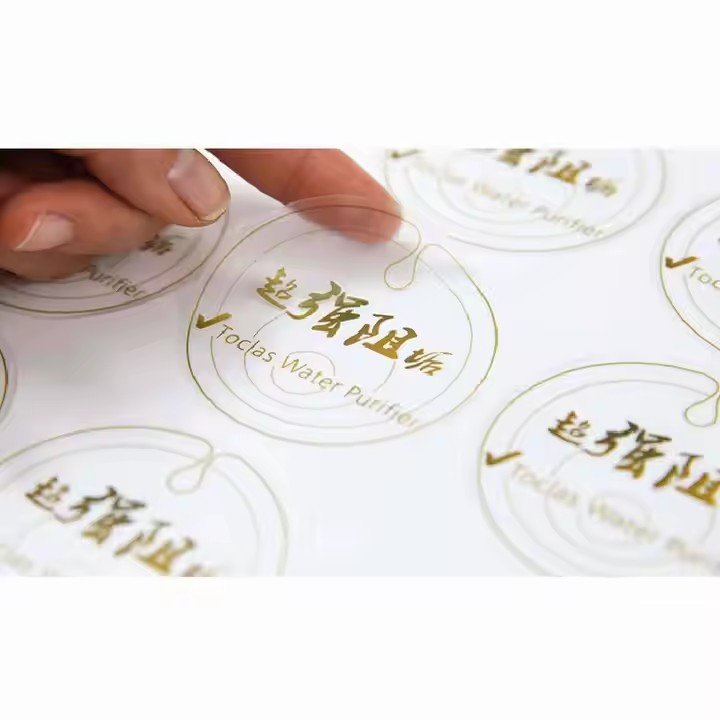
From a user experience perspective, ease of opening and readability are critical. For elderly users, tear lines can be slightly widened, or pull tabs can be added to the label edge to facilitate manual opening. Label dimensions must match the bottle size—labels that are too large tend to wrinkle, while those too small may obscure information. As a general guideline, when the cap diameter is 20–30 mm, the label diameter should be 2–3 mm larger than the cap.
To prevent glare, transparent labels should avoid excessive reflectivity. Matte finishes or optimized printing angles can be used to ensure information remains legible under various lighting conditions.
V. Pitfall Avoidance: Reducing Design and Application Risks
Three common pitfalls should be avoided to ensure both practicality and compliance.
First, avoid over-design—adding unnecessary graphics or decorative elements for visual appeal may obscure information or introduce non-compliant colors and fonts, violating pharmaceutical regulations.
Second, avoid mixed or non-compliant materials. All label components (film, adhesive, and ink) must meet pharmaceutical-grade standards; failure in any single component can compromise overall safety.
Third, do not ignore environmental adaptability. For extreme storage conditions such as high temperature, low temperature, or high humidity, label performance should be tested in advance to prevent deformation, adhesive failure, or ink bleeding.