
professional in one-stop Packaging Labels solutions
e-mail:hxmdlz@hxmpackage.com
Shenzhen Huaxinmei Printing Co., Ltd.
Features
- Design
- why choose us
- Our Advantage
- How to use
- Our Services
FAQ
- Support
- certification
- payment
- customization
- Privacy Policy
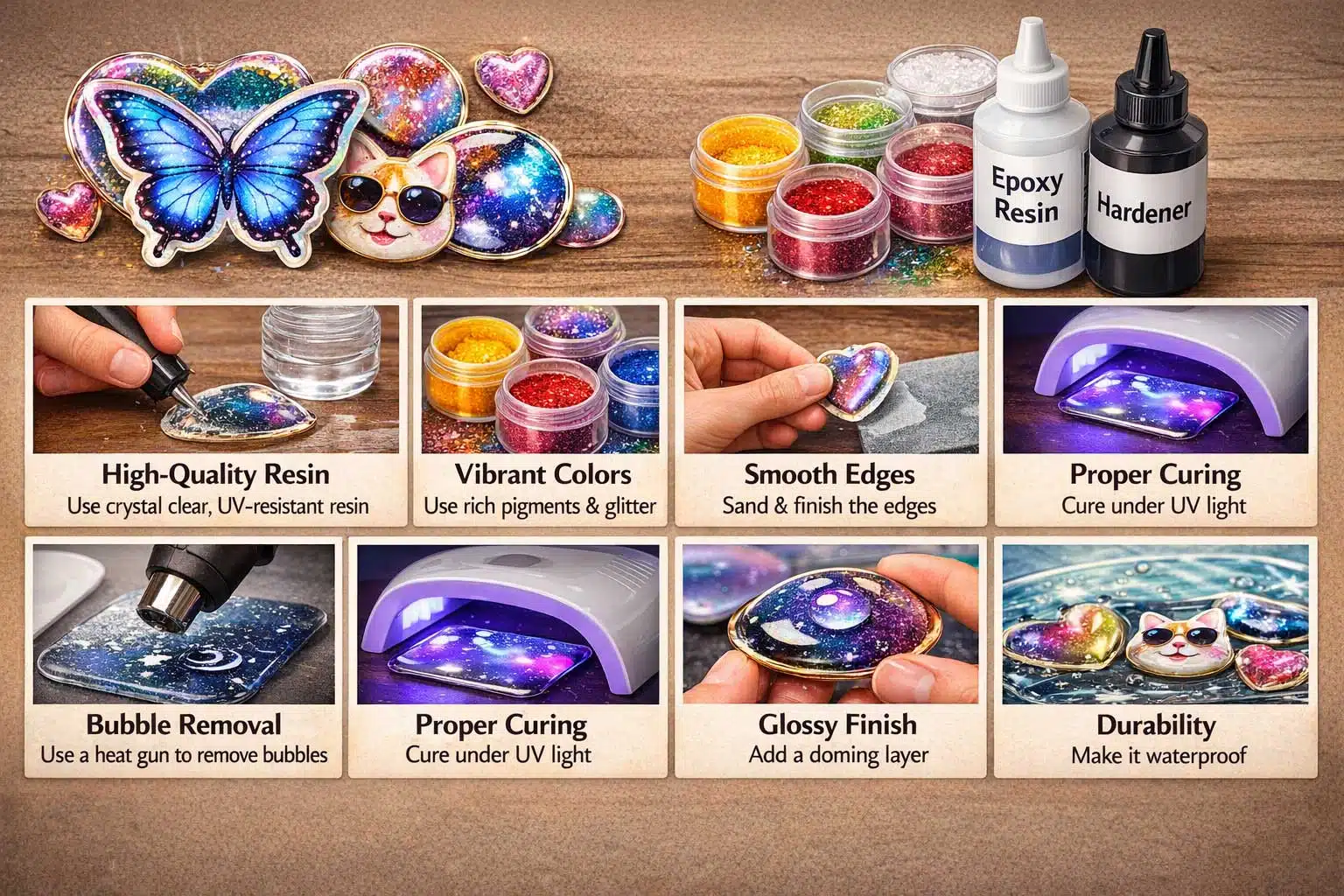
In the precision-driven sectors of automotive interiors, medical devices, and high-end industrial controls, a 3D brand identity—commonly known as an Epoxy Resin Sticker—is far more than a decorative element. It is a functional component that must withstand harsh environmental stressors while maintaining optical clarity.
For a global procurement manager, the challenge isn’t finding a “shiny” label; it’s mitigating the risk of sub-surface delamination, UV-induced yellowing, and adhesive migration over a 5-to-10-year product lifecycle. This technical guide outlines the critical design and manufacturing parameters required to ensure “Technical Certainty” in your supply chain.
The term “Epoxy Sticker” is often used as a generic industry catch-all, but for B2B applications, the chemical composition is the first point of failure or success.
Comparative Technical Data: PU vs. Epoxy
| Technical Property | Automotive-Grade PU | Industrial Epoxy | Testing Standard |
| UV Resistance (Yellowing Index) | < 1.0 ΔE after 1000h | > 5.0 ΔE (Significant yellowing) | ASTM G154 (Cycle 1) |
| Service Temperature Range | -40°C to +120°C | -10°C to +80°C | IEC 60068-2-14 |
| Shore D Hardness | 25 – 45 (Flexible) | 70 – 85 (Rigid/Brittle) | ASTM D2240 |
| Chemical Resistance (Gasoline/MEK) | No visible change (24h) | Surface clouding/Swelling | ISO 2812-1 |
| Flammability Rating | UL 94 V-0 / V-2 | Non-rated | UL 94 |
Export to Sheets
To prevent manufacturing defects such as “edge-curling” or “bubble entrapment,” the design phase must adhere to specific mechanical tolerances.
Sharp 90-degree corners are the primary cause of dome collapse. High-viscosity resin relies on surface tension to create that signature “glossy dome.”
In B2B sourcing, “outgassing” is a silent killer. If using solvent-based inks, any residual VOCs (Volatile Organic Compounds) trapped under the resin will create micro-bubbles over time.
For electronics and automotive applications, top-coated PET (Polyethylene Terephthalate) is the technical benchmark. It offers superior thermal stability compared to PVC, preventing the “shrinkage gap” that often appears after 100+ thermal cycles.
Quality in premium label manufacturing is not checked; it is built into the process. At our facility, the following Automated Quality Control (AQC) steps are non-negotiable:
The misconception that China sourcing is only for “low cost” is outdated. In the current B2B landscape, the advantage lies in Agility and Integrated Compliance.
For procurement managers in the EU and North America, compliance is a “Hard Gate.” Our Epoxy Resin Stickers are engineered to meet:
Q: Why do some resin stickers become “tacky” or sticky over time? A: This is a symptom of improper mixing ratios or high humidity during the curing phase. We use automated dual-cartridge mixing systems that maintain a precise 1:1 or 2:1 ratio by weight, ensuring a 100% cross-linked polymer structure that remains dry and glossy for the life of the product.
Q: Can these labels withstand high-pressure washing (IP69K environments)? A: Yes, provided the adhesive is a high-tack acrylic (e.g., 3M 467MP). The PU dome protects the printed graphics, while the adhesive ensures the seal remains intact during 1450 psi wash-downs.
Q: What is the impact of resin height on long-term adhesion? A: A dome that is too high increases the “lever effect” on the edges. We recommend a dome height of 1.5mm to 2.2mm. This provides the 3D aesthetic without creating excessive internal stress that could lead to edge lifting (winging).
The difference between a failing label and a brand-enhancing component lies in the technical specification.
professional in one-stop Packaging Labels solutions
e-mail:hxmdlz@hxmpackage.com
Shenzhen Huaxinmei Printing Co., Ltd.
Fill in the form below to book a 30 min no-obligation consulting session.
I will reply within 24 hours.