

professional in one-stop Packaging Labels solutions
e-mail:hxmdlz@hxmpackage.com
Shenzhen Huaxinmei Printing Co., Ltd.
Features
- Design
- why choose us
- Our Advantage
- How to use
- Our Services
FAQ
- Support
- certification
- payment
- customization
- Privacy Policy
Fruit sticker icons must allow consumers to “recognize them at a glance.” The key lies in amplifying each fruit’s distinctive features and avoiding homogenized designs.
Color Accuracy + Saturation Enhancement
Base the icon colors on the fruit’s natural appearance, then enhance saturation to create stronger visual impact.
For example, strawberry icons can use vivid rose-red paired with fresh green calyxes; mango icons can adopt gradient orange-yellow tones to convey plump, juicy flesh; blueberry icons can feature deep purple gradients with light blue highlights to reflect a fresh, moist texture. Avoid dull or muted colors that may cause the icon to visually “disappear” against the fruit skin or packaging.
Simplified Shapes + Exaggerated Details
Abandon overly realistic, complex illustration styles in favor of flat or minimalist line designs that outline the fruit’s basic form, while exaggerating key features to enhance memorability.
For instance, orange icons can highlight the textured peel and navel detail; kiwi icons can enlarge the iconic black seed pattern; mangosteen icons can emphasize the segmented shell structure. Simplified forms improve print clarity and recognition on small-sized stickers, while exaggerated details help differentiate similar products.

Different sales channels and consumer groups have distinct preferences for icon styles, requiring targeted design strategies.
Premium Gift Boxes: Light Luxury Minimalist Icons
For high-end fruit gift boxes (such as imported cherries or Shine Muscat grapes), use minimalist line work combined with low-saturation Morandi color palettes, enhanced with hot stamping or embossing techniques.
For example, design Shine Muscat grapes as a single, simplified cluster outline, with light purple color blocks for the grapes and fine gold lines for the stem. The overall effect is refined and understated, aligning with premium consumers’ expectations of quality. Simple origin-related landmark icons (such as cherry blossoms for Okayama, Japan, or sunshine symbols for California, USA) can also be incorporated to reinforce the premium positioning.
Supermarket Retail: Lively and Bold Icons
In supermarkets where fruit categories are densely displayed, icons must deliver strong visual impact. Use cartoon-style, exaggerated designs paired with high-contrast colors.
For example, apples can be illustrated as rounded smiling faces; bananas can feature curved, dynamic lines; watermelon icons can use striking red-and-green contrasts to emphasize their patterns. Such designs quickly capture the attention of children and family shoppers, improving shelf recognition.
Move beyond traditional one-way visual presentation by introducing interactive elements that make the icons more engaging and memorable.
Playful Puns + Cultural Symbol Integration
Incorporate homophonic wordplay or cultural symbolism related to fruit names to evoke emotional resonance.
For example, persimmon icons paired with the phrase “Everything Goes Your Way,” orange icons with “Wishes Come True,” or tangerine icons designed as red envelopes symbolizing good fortune. These designs are especially suitable for festive gift boxes and encourage social sharing, boosting brand exposure.
Interactive Detail Design
Add small interactive elements to the icon. For instance, design lemon icons with a peel-off “acidity test” label that reveals “Perfectly Balanced Sweet & Sour” after removal; or add arrow-guided “peeling tips” to pineapple icons, offering extra value during use.
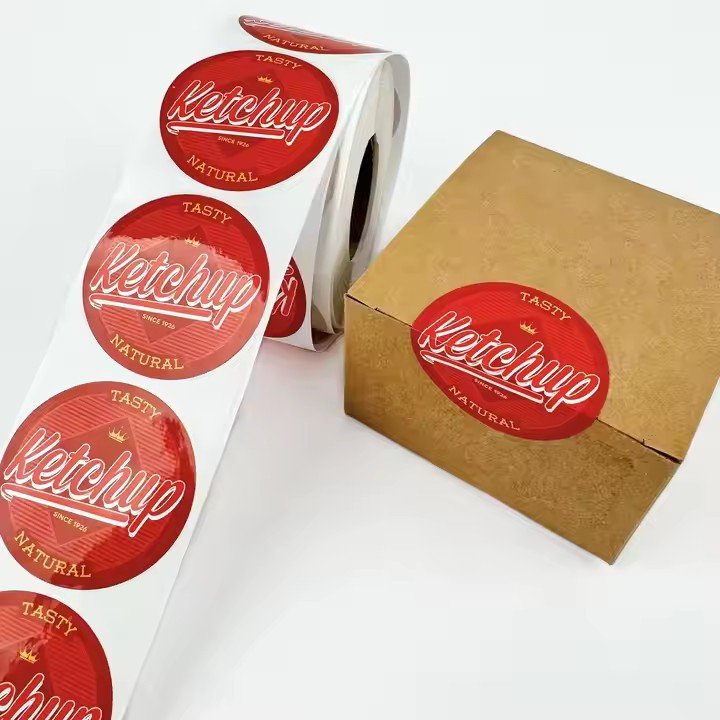
The attractiveness of an icon relies on appropriate materials and printing processes, each delivering distinct visual effects.
Transparent Stickers: Outline-Only Icons Without Backgrounds
Transparent stickers are commonly used on fruit packaging. Icons should adopt “no background + bold outlines” to avoid covering the fruit’s surface.
For example, use thick gold or black lines to outline a strawberry, with green fill for the calyx. The transparent background allows the icon to blend naturally with the fruit, creating a fresh and clean look.
Hot Foil (Gold/Silver): Minimalist Line Icons
Hot stamping enhances premium perception and is ideal for high-end fruit stickers. Designs should simplify details and use clean lines or large color blocks to avoid blurred foil edges.
For example, design a mango icon as a solid shape with gold foil outlining the edges, achieving an elegant, durable finish.
Fluorescent / Glow-in-the-Dark Finishes: Night Market Icons
For night markets or street stalls, fluorescent materials can be used to increase visibility.
For instance, watermelon or lychee icons can incorporate neon green or neon pink to stand out under nighttime lighting. Designs should remain simple to prevent visual clutter from excessive fluorescent colors.
Icon design must balance creativity with regulatory compliance to ensure accurate information delivery.
Avoid Misleading Designs
Icons must accurately represent the fruit variety. For example, Shine Muscat grape icons should not resemble generic grapes, but highlight characteristics such as plump, seedless berries. Organic fruit icons must include certified organic logos, with logo sizes compliant with relevant regulations.
Control Icon Size and Proportions
Fruit stickers are typically small (2–5 cm in diameter), so detail density must be carefully controlled to ensure clarity at reduced sizes. Avoid excessive text or complex patterns that may blur during printing.
professional in one-stop Packaging Labels solutions
e-mail:hxmdlz@hxmpackage.com
Shenzhen Huaxinmei Printing Co., Ltd.
Fill in the form below to book a 30 min no-obligation consulting session.
I will reply within 24 hours.