

professional in one-stop Packaging Labels solutions
e-mail:hxmdlz@hxmpackage.com
Shenzhen Huaxinmei Printing Co., Ltd.
Features
- Design
- why choose us
- Our Advantage
- How to use
- Our Services
FAQ
- Support
- certification
- payment
- customization
- Privacy Policy
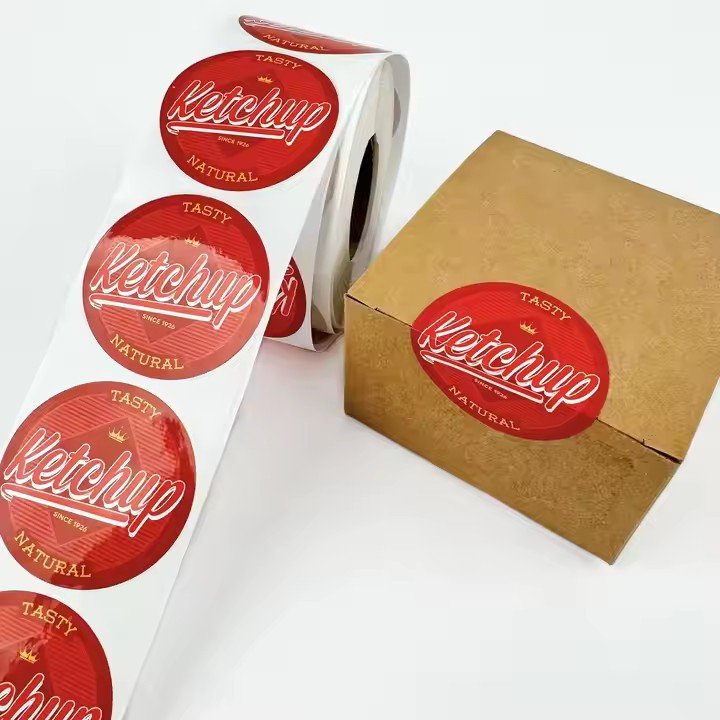
The design of fruit carton sealing labels should follow four major principles: function first, accurate information, controlled cost, and brand alignment. Among these, function first is the top priority. Fruit is a highly perishable category, and transportation requires strict control of temperature, humidity, stacking methods, and handling force. Labels must use clear warnings to reduce logistics losses—for example, soft fruits such as strawberries and blueberries require prominent warnings like “Do Not Stack” or “Handle with Care,” while storage-tolerant fruits such as citrus and apples can focus more on warehouse turnover information.
The principle of accurate information requires removing unnecessary content and retaining only the essential data. According to the Administrative Measures for Packaging and Labeling of Agricultural Products, fruit labels must clearly display the product name, place of origin, producer, production date, and shelf life. Imported fruits must also include the entry inspection and quarantine certificate number. All information must be easy to read, without blur or omission.
The cost-control principle requires selecting materials and processes based on production scale. Small-scale growers can use standardized templates, while large-scale enterprises may adopt customized labels to enhance brand value. The brand-alignment principle emphasizes consistency between label style and brand identity—organic fruit may use green as the primary color, while premium imported fruit can use gold foil stamping to convey quality.

Information on fruit sealing labels should be structured into three tiers—logistics layer, management layer, and consumer layer—ensuring that different users can quickly find what they need.
Logistics-layer information, placed in highly visible areas, should use large text and high-contrast colors. Core elements include warning symbols and temperature/humidity requirements. Use internationally recognized icons such as upward arrows for correct orientation, water-droplet symbols for “keep dry,” and thermometers for temperature ranges. Supplement icons with concise descriptions, such as “Refrigerated Transport 0–4°C, Humidity 85–90%.” Use bold or sans-serif fonts with a size no smaller than 12 pt.
Management-layer information supports businesses and regulators, including product information, traceability data, and batch identifiers. Product details should specify variety (e.g., “Shine Muscat Grapes” instead of simply “Grapes”), specifications (e.g., “5 kg/box; 12–15 g per fruit”), and origin (down to county or city level, e.g., “Yuanmou, Yunnan”). Traceability information should be provided via QR codes linking to planting records, fertilizer logs, harvest time, and testing reports to facilitate regulatory inspection and consumer verification. Batch information includes batch number and production date, formatted as “20251211-001” for precise issue tracking.
Consumer-layer information focuses on brand communication and usage guidance, positioned on the label’s side or top. This layer includes brand logos, slogans, and purchasing tips. The logo should occupy 10–15% of the label area without obstructing key information. The slogan should reflect the fruit’s characteristics, such as “Freshly Picked, Direct from Orchard.” Usage tips may include “Refrigerate promptly after opening; best consumed within 7 days.” Imported fruits should include multilingual information, at minimum Chinese and English, including “Country of Origin” and “Importer.”
Different distribution scenarios impose different requirements. Cold-chain transport labels must focus on low-temperature resistance and water resistance. Materials such as PE synthetic paper and UV inks are recommended to prevent brittleness or ink shedding in low temperatures. Labels should include a “cold-chain break alert,” such as “If the internal temperature exceeds 8°C, please contact 400-XXX-XXXX,” reducing spoilage risks.

Material selection is fundamental and should match fruit characteristics and distribution duration.
For short-cycle fruits like berries, kraft paper is ideal due to its low cost and biodegradability; pair it with water-based adhesives to avoid contaminating the fruit.
For long-distance transport of apples or pears, PET composite paper is suitable due to its abrasion resistance and tear strength.
Adhesives should preferably be removable type to prevent residue after opening, allowing reuse of outer packaging.
Printing processes must balance clarity and cost. Core information such as traceability codes and warnings should use letterpress printing for maximum legibility, while brand elements can use flexographic printing for better color performance during mass production. For color choices, avoid overly bright colors; opt for natural hues such as green or orange to match fruit imagery. Warning messages should use strong contrasts such as white text on red or black text on yellow to ensure visibility from a distance.
Avoid three major pitfalls:
Information overload —Some labels include unnecessary details such as planting techniques or full nutritional data, which distract from essential information. Use a “core information first” approach and place non-essential content in QR-code links.
Ignoring environmental requirements —Prioritize biodegradable materials and avoid non-recyclable plastics to comply with policies regarding green packaging of agricultural products.
Lack of anti-counterfeiting measures —Add invisible fluorescent markers that reveal a security code under a special pen to prevent counterfeiting.
professional in one-stop Packaging Labels solutions
e-mail:hxmdlz@hxmpackage.com
Shenzhen Huaxinmei Printing Co., Ltd.
Fill in the form below to book a 30 min no-obligation consulting session.
I will reply within 24 hours.