
professional in one-stop Packaging Labels solutions
e-mail:hxmdlz@hxmpackage.com
Shenzhen Huaxinmei Printing Co., Ltd.
Features
- Design
- why choose us
- Our Advantage
- How to use
- Our Services
FAQ
- Support
- certification
- payment
- customization
- Privacy Policy
As both an aesthetic element and a carrier of brand information, candle labels play a vital role in product presentation. However, the heat generated during candle burning often causes labels to curl, deform, or even melt—damaging visual appeal and potentially raising quality concerns among consumers. Solving this issue requires precisely matching label materials to the candle’s usage environment, considering factors such as heat resistance, adhesion stability, and environmental adaptability. This article breaks down the temperature characteristics around candles, evaluates material suitability, and provides scientifically grounded recommendations for selecting the right label materials.
Before choosing materials, it is essential to understand the heat distribution pattern when a candle burns—this is the key basis for material selection. The core of the flame can reach 800–1000°C, but this heat significantly decreases as it spreads through the candle body, creating clear temperature differences in various areas: the zone within 1–2 cm around the wick is the hottest, reaching 60–80°C; the mid-to-lower body of the candle remains much milder at around 30–50°C. Labels placed on candle lids or external packaging remain near room temperature. For container candles such as scented candles, glass or ceramic vessels conduct heat, causing the outer wall temperature to rise—small jars may reach 50–70°C. Additionally, storage during hot weather (e.g., summer transport trucks) can cause label adhesion issues due to elevated ambient temperatures. Therefore, label materials must withstand at least 25–80°C, with the exact requirement depending on label placement.
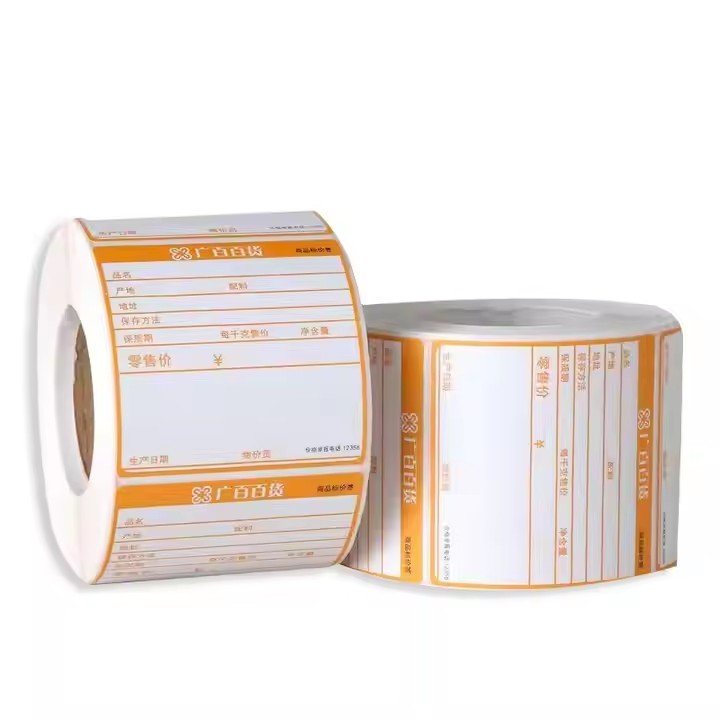
Heat-resistant synthetic films are the top choice for labels applied directly to the candle surface. PET (polyethylene terephthalate) film is the most widely used option, offering heat resistance above 120°C—more than enough for the hottest parts of a candle. PET also provides excellent tensile strength and chemical resistance, preventing damage even when exposed to melted wax. PET labels come in glossy and matte finishes: glossy PET works well with foil stamping, while matte PET suits minimalist or “ins-style” branding. For candles, it is recommended to choose PET films with a thickness of 80–120 μm—thin PET films may shrink slightly under high temperatures and lose flatness.
PVC (polyvinyl chloride) film is another option, with heat resistance around 60–80°C—suitable for mid-to-lower candle areas and more cost-efficient than PET. However, PVC has two clear drawbacks: its heat resistance is lower, making it prone to edge softening if applied too close to the flame; and its environmental performance is poor, with strict PVC restrictions in many European and American markets. A similar material, PP (polypropylene), has better environmental performance and can withstand temperatures up to 100°C, but its low-temperature resistance is weaker—PP labels may become brittle in colder storage environments.
For labels applied to lids or external packaging—far from the heat source—paper materials can be used as long as they receive proper surface treatment. Kraft paper is a popular choice, but its natural fibers absorb moisture and lack heat resistance, so it must be laminated with a BOPP (biaxially oriented polypropylene) or PET film to achieve heat resistance above 70°C and prevent wax absorption. Coated paper with UV-curing treatment is also suitable for outer packaging; the UV coating forms a dense protective layer that improves heat resistance, enhances abrasion resistance, and adds gloss. However, untreated paper labels should never be applied directly to candle surfaces or hot container walls, or melting/charring will inevitably occur.

Beyond base materials, the adhesive determines whether a label remains firmly attached under heat—yet it is often overlooked. Standard water-based adhesives may soften and fail above 50°C, causing label detachment, so heat-resistant pressure-sensitive adhesives must be used. These adhesives, typically formulated with synthetic rubber or acrylics, maintain strong adhesion at 80–150°C. The adhesive layer should be applied evenly, and air bubbles must be avoided during application, as thin or uneven sections can fail under heat. For container candles, selecting adhesives with thermal buffering properties can reduce the impact of conducted heat from the vessel wall.
Material choice must also be tailored to the type of candle and its usage scenario. Pillar candles require PET film combined with heat-resistant adhesive, and the label edge should be placed at least 2 cm away from the wick to avoid the high-temperature zone. Jar or cup candles allow labels to be applied to the outer vessel wall—small jars should use PET, while large jars (over 10 cm diameter) can use PP film or laminated kraft paper. Outdoor candles require labels with heat resistance, waterproofing, and abrasion resistance—PET films with a matte, scratch-resistant coating are ideal. For cold-chain transported scented candles, label materials must also withstand low temperatures to avoid adhesive failure or material brittleness.
professional in one-stop Packaging Labels solutions
e-mail:hxmdlz@hxmpackage.com
Shenzhen Huaxinmei Printing Co., Ltd.
Fill in the form below to book a 30 min no-obligation consulting session.
I will reply within 24 hours.