

I. Core Principles for Material Selection: “Medical-Grade Safety” as the Fundamental Logic
Material selection for photopolymer stickers in the medical industry must go beyond the basic needs of “appearance and adhesion.” It must strictly follow a safety-first, performance-matched, and compliance-traceable logic. Three core principles are indispensable:
- Principle 1: Zero Biological Safety Risk
Materials must comply with biocompatibility requirements and avoid releasing harmful substances during direct or indirect human contact. Core requirements include:
The photopolymer base film, adhesive, and curing agents must be free of heavy metals (lead, mercury, cadmium), formaldehyde, and volatile organic compound (VOC) residues.
Adhesives must use medical-grade low-migration formulas to prevent plasticizers or monomers from migrating to the skin or contaminating medical environments.
For medical device stickers with direct skin contact, materials must pass:
ISO 10993-5 cytotoxicity test (rating ≤ Grade 1)
ISO 10993-10 irritation and sensitization test (no allergic reaction)
ensuring long-term contact without redness, irritation, or allergic risks.
- Principle 2: High Resistance to Environmental Stress
Photopolymer stickers used in medical environments must withstand extreme conditions, including:
Sterilization (high-temperature steam, UV, ethylene oxide)
Disinfection (alcohol, iodine, hydrogen peroxide)
Temperature cycles (−40°C to 121°C)
Humidity (operating rooms, CSSD)
Key requirements include:
Base film sterilization resistance — no shrinkage or deformation
Adhesive chemical resistance — no dissolution or detachment after repeated wiping
Surface coating abrasion resistance — no color fading or damage during long-term use
For example, stickers used on surgical instruments must withstand:
134°C high-pressure steam sterilization (30 min) for at least 50 cycles,
while maintaining adhesion and clarity.
- Principle 3: Precise Functional Adaptation
Material choices must match the functional priority of each medical scenario:
Diagnostic products → high light transmittance, biomolecule compatibility

Device protection → insulation, anti-glare
Disposable consumables → lightweight, easy removal
Avoid one-size-fits-all materials; select based on functional needs such as optical clarity or sterilization resistance.
II. Key Component Selection Standards: Medical-Grade Base Film, Adhesive, and Coating
Photopolymer sticker material systems consist of:
Base film + Adhesive + Photopolymer curing system + Surface coating
Each component must meet medical-industry requirements and work synergistically.
(1) Base Film Selection: Stability and Functional Performance
The base film must provide dimensional stability, sterilization resistance, and functional fit. Common medical-grade base films include:
- PET Base Film (Polyester)
The first choice for medical labels.
Thickness: 12–50 μm
Temperature resistance: −40°C to 150°C
Chemical resistance: resistant to alcohol, iodine, and disinfectants
Dimensional stability: heat shrinkage ≤1%
Selection requirements:
Use food-grade PET with no additives
Avoid recycled PET (may contain impurities)
Surface must be corona-treated for improved adhesion and high-resolution printing (≥1200 dpi)
Applications: medical device labels, disposable consumable labels.
- PI Base Film (Polyimide)
Used for high-temperature sterilization or high-heat environments.
Temperature resistance: −269°C to 300°C
Excellent chemical resistance and insulation
Thickness: 25–75 μm
Selection requirements:
Use medical-grade pure PI (no fluorinated compounds)
No brittleness or cracking after repeated sterilization cycles
Applications: surgical instrument labels, labels inside high-temperature equipment.
- Polyolefin Base Films (PO: PE, PP)
Lightweight, flexible, and easy to remove.
Best for disposable medical consumables: syringes, IV sets, catheters.
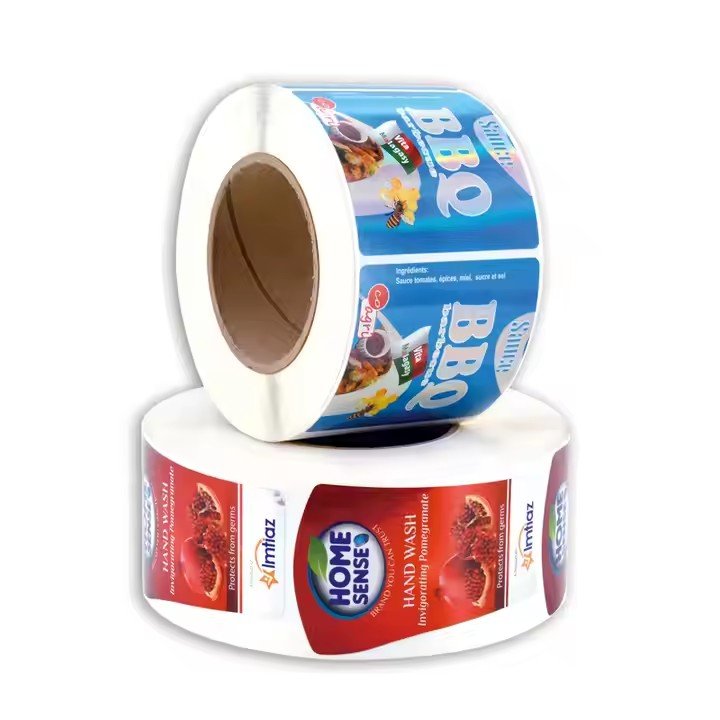
Selection requirements:
Use LDPE or metallocene PP (mPP)
Must pass ISO 10993-11 biocompatibility
Heavy metal content ≤10 ppm
Must ensure compatibility with plastic or glass surfaces
- Special Functional Films
Depending on application:
Diagnostics: optical-grade PET or PC with ≥92% light transmittance
Protective films: anti-glare and anti-fingerprint coatings without reducing touch sensitivity
(2) Adhesive Selection: Medical-Grade, Low-Migration, Sterilization-Resistant
Adhesive selection is crucial for adhesion stability and biological safety. Requirements:
Preferred Adhesive Types:
Medical-grade acrylic UV-curable adhesive
Medical-grade silicone adhesive
Avoid:
Solvent-based adhesives (contain VOCs)
Rubber adhesives (aging, migration)
Acrylic adhesives:
180° peel strength ≥1.5 N/25 mm
Excellent chemical resistance
Suitable for most medical scenarios
Silicone adhesives:
Gentle, non-irritating
Ideal for skin-contact applications
Easy to remove without residue
Applications: device fixation stickers, skin-interface tapes.
