
professional in one-stop Packaging Labels solutions
e-mail:hxmdlz@hxmpackage.com
Shenzhen Huaxinmei Printing Co., Ltd.
Features
- Design
- why choose us
- Our Advantage
- How to use
- Our Services
FAQ
- Support
- certification
- payment
- customization
- Privacy Policy
The base material is the “skeleton” of a warning label. It directly determines the label’s mechanical strength, resistance to environmental corrosion, and service life. Materials should be selected according to the severity of the application environment, with priority given to tear resistance, aging resistance, and tolerance to temperature and chemicals.
1. Industrial-Grade Plastic Substrates: Balancing Strength and Adaptability
For industrial applications (such as equipment housings and machinery components), priority should be given to polyimide (PI), polyester (PET), polypropylene (PP), or polyvinyl chloride (PVC) substrates. These materials offer excellent tear resistance, abrasion resistance, and chemical resistance.
PI substrate (commonly known as “Kapton”) has an extremely wide temperature tolerance from –269°C to 260°C, making it ideal for high-temperature equipment such as engines and boilers.
PET substrate withstands temperatures from –40°C to 120°C, offers high mechanical strength, and resists deformation. It is the preferred choice for general industrial applications. A thickness of 100–150 μm is recommended to improve scratch resistance.
PVC substrate provides good flexibility and strong weather resistance, making it suitable for curved or irregular surfaces. A matte surface treatment can further enhance abrasion resistance.
PP substrate features excellent chemical resistance, making it ideal for chemical containers and laboratory equipment exposed to acids and alkalis.
The printing layer is the “core information carrier” of a warning label. Text and graphics must remain clear and legible over long-term use without fading or blurring. This depends on selecting printing processes and inks with strong weather resistance and abrasion resistance, preventing information loss caused by friction, UV exposure, or chemical attack.
1. Ink Selection: Focus on Aging Resistance and Corrosion Resistance
Priority should be given to UV-curable inks, solvent-based inks, or thermal transfer ribbons, while avoiding ordinary water-based inks (which have poor weather resistance and fade easily).
UV-curable inks form a hard coating after UV curing, offering excellent UV resistance, scratch resistance, and chemical resistance. They are suitable for outdoor or high-contact applications.
Solvent-based inks provide strong adhesion and resistance to water, oil, acids, and alkalis, making them suitable for industrial equipment and chemical environments.
Thermal transfer ribbons (resin-based or mixed resin/wax types) are highly compatible with PET, PP, and other plastic substrates. They produce sharp images with strong abrasion resistance and are particularly suitable for barcodes or fine warning graphics requiring long-term durability. Among them, resin-based ribbons offer the best heat and chemical resistance for harsh environments.

The adhesive is the “bond” between the label and the application surface. Its durability directly determines whether the label will curl or detach. Adhesives should be selected based on surface materials (metal, plastic, rubber, concrete) and environmental conditions (temperature, humidity, corrosiveness), balancing initial tack and long-term holding power.
1. Pressure-Sensitive Adhesives: The Preferred Choice for General Applications
For most applications (such as equipment housings, electronics, and packaging), acrylic pressure-sensitive adhesives or silicone pressure-sensitive adhesives are recommended.
Acrylic pressure-sensitive adhesives offer excellent weather resistance, temperature resistance (–40°C to 120°C), and strong adhesion. They are compatible with a wide range of materials, provide strong holding power, resist UV aging, and are suitable for long-term indoor and outdoor use.
Silicone pressure-sensitive adhesives have a wider temperature range (–60°C to 200°C) and are suitable for high-temperature equipment or low-surface-energy materials such as silicone rubber and PTFE. However, they are relatively more expensive and are best used in specialized applications.
2. Specialty Adhesives: Meeting Complex Bonding Requirements
For humid environments (such as bathroom equipment or underwater instruments) or corrosive environments (such as chemical containers), waterproof or chemical-resistant adhesives—such as butyl rubber adhesives or polyurethane adhesives—should be used.
Butyl rubber adhesives provide excellent waterproof and moisture-resistant performance with strong sealing properties, making them suitable for long-term exposure to water or high humidity.
Polyurethane adhesives offer strong adhesion and chemical resistance, effectively withstanding acids, alkalis, and solvents, making them ideal for chemical industry applications.
For rough surfaces (such as concrete or cast metal), high-viscosity, gap-filling adhesives should be selected to ensure close contact between the label and the surface, preventing water ingress and subsequent peeling.
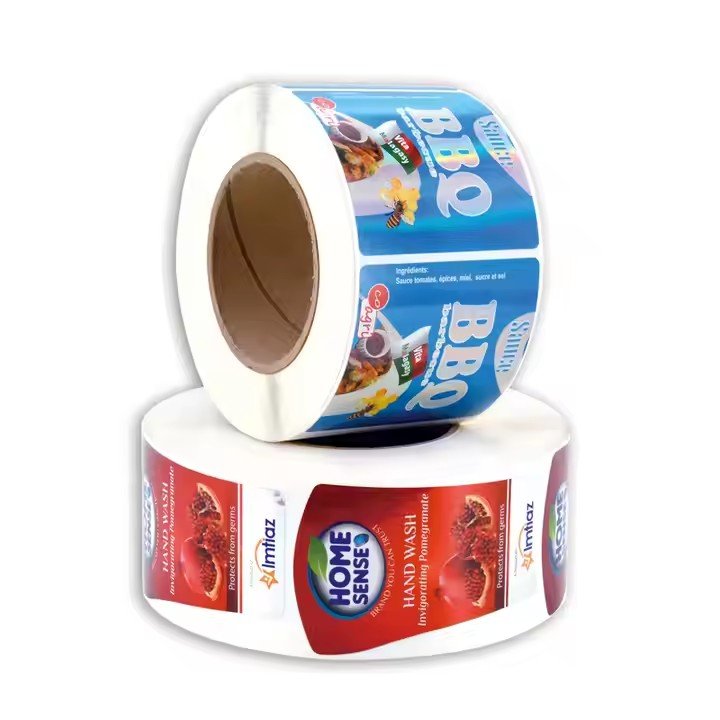
The protective layer acts as the label’s “shield.” By adding a protective coating or laminate over the printed surface, it helps resist abrasion, UV radiation, and chemical exposure, significantly extending the label’s service life—especially in high-contact or outdoor applications.
1. Lamination Protection: Improving Abrasion and Weather Resistance
A transparent polycarbonate (PC) film, PET film, or PVC film can be laminated over the printed layer using hot or cold lamination processes.
PC film offers outstanding impact resistance and scratch resistance and is the preferred option for industrial applications.
PET film provides high transparency and strong weather resistance, making it suitable for applications where label clarity is critical.
PVC film is flexible and well-suited for curved surfaces.
During lamination, materials compatible with the ink should be selected to avoid bubbling or delamination. Matte laminates are recommended to reduce glare and improve the readability of warning information.
Different environments present varying challenges in terms of corrosion, temperature and humidity fluctuations, and abrasion frequency. Materials should therefore be combined strategically—substrate, printing layer, adhesive, and protective layer—to ensure durability under specific conditions.
1. Outdoor Applications (such as outdoor equipment and building façades)
Key challenges: UV exposure, wind and rain, and temperature fluctuations.
Recommended material combination:
PET substrate + UV-curable ink + acrylic pressure-sensitive adhesive + PC laminate + edge sealing.
PET provides strong weather resistance, UV ink prevents fading, PC lamination protects against rain and abrasion, acrylic adhesive accommodates temperature changes, and edge sealing prevents water penetration.
professional in one-stop Packaging Labels solutions
e-mail:hxmdlz@hxmpackage.com
Shenzhen Huaxinmei Printing Co., Ltd.
Fill in the form below to book a 30 min no-obligation consulting session.
I will reply within 24 hours.