
Car Battery Labels Explained: What Every Letter And Number Means
Car battery labels identify a battery’s voltage, starting capability, storage capacity, physical fit, and construction type. Understanding those markings helps you compare replacements without confusing a bigger number with a better match. This guide explains the common letters, numbers, and safety symbols—and where a manufacturer-specific code needs confirmation rather than guesswork.
What do the letters and numbers on a car battery label mean?
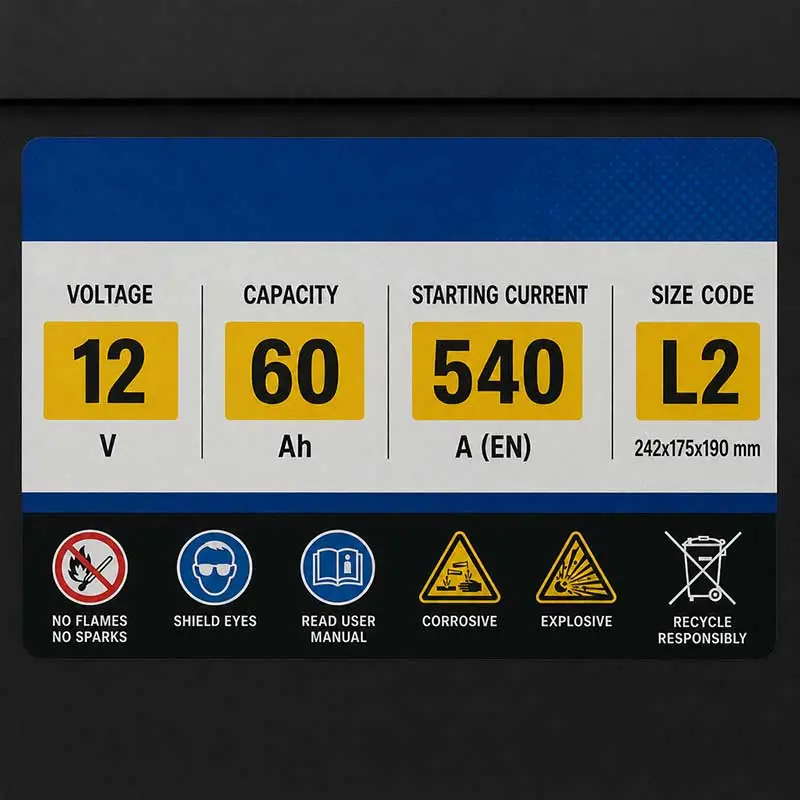
The letters generally identify a measurement, battery technology, testing standard, or product family; the numbers supply its rating or classification. For example, 12 V describes nominal voltage, 70 Ah describes capacity, and 760 A (EN) describes starting current measured under a specified standard. A separate size designation tells you about fit, not electrical performance.
Table of Contents
Start by separating the label into three categories: electrical ratings, fitment information, and handling instructions. That prevents a common mistake: treating every prominent number as a measure of starting power. Manufacturer part numbers may combine several details, so their individual letters are not universally interchangeable.
Electrical ratings: voltage, starting power, and capacity
These ratings answer different questions. Voltage identifies the electrical system the battery serves; starting-current ratings describe cranking performance; capacity ratings describe stored charge or sustained output. Compare like-for-like measurements rather than choosing whichever battery displays the largest figure.
Marking | Meaning | Practical implication |
|---|---|---|
V | Volts; nominal battery voltage | Match the vehicle’s specified voltage. |
CCA | Cold cranking amps | Check the required cold-start rating. |
CA | Cranking amps | Do not substitute this warmer-temperature rating for CCA. |
Ah | Ampere-hours | Compare capacity at the same discharge rate. |
RC | Reserve capacity, expressed in minutes | Compare sustained output under standardized conditions. |
These abbreviations describe separate characteristics, not competing ways of expressing one rating.
CCA and CA are not interchangeable
CCA describes starting performance in severe cold. Under the commonly used American test, it measures the current a fully charged battery can supply at 0°F for 30 seconds while maintaining the specified minimum voltage. CA is measured at 32°F, so it can produce a higher-looking figure without demonstrating stronger cold-weather performance.
Letters such as EN, SAE, DIN, or IEC beside a current rating identify its testing standard. Different procedures can produce different ratings for the same battery. Match the vehicle’s requirement using the same standard, or obtain a verified equivalent instead of comparing bare numbers.
Ah and RC describe capacity differently
An Ah rating expresses charge capacity at a stated discharge rate. At the 20-hour rate, a 60 Ah rating corresponds to a 3-amp discharge over 20 hours under the specified test conditions. It does not promise that every larger load will receive proportionally shorter runtime.
RC measures minutes under a different test: a fully charged battery supplies 25 amps at 80°F until voltage reaches the specified cutoff. It helps compare reserve performance, but it is not a guaranteed countdown for driving with a failed charging system. Actual vehicle loads and battery condition differ from laboratory conditions.
Size codes determine whether the battery fits
Car battery codes often identify physical dimensions and terminal arrangements rather than capacity. A battery can have suitable electrical ratings yet still be the wrong replacement because its case, hold-down, terminals, or clearance does not match. Verify fitment before treating two batteries as equivalent.
Common systems include:
- Group sizes: Codes such as 24F or 51R identify standardized battery configurations. Retain the complete designation, including suffixes, when checking a replacement.
- European case references: Labels may show codes such as H6 or LN3. Use an application listing to confirm the corresponding dimensions and installation requirements.
- Japanese-style designations: A code such as 55D23L combines a performance classification, case dimensions, and terminal-layout information.
In 55D23L, “55” is a performance classification, not a 55 Ah capacity claim. “D” identifies a width-and-height category, “23” indicates approximate length in centimeters, and “L” identifies the terminal arrangement. Confirm polarity against the actual positive and negative markings rather than relying on an assumed viewing direction.
Longer European type numbers can encode capacity, construction details, and starting performance. They require the correct decoding reference; do not apply a Japanese or American interpretation to a European number. The useful car battery info is the verified specification behind the code, not a guessed meaning for each character.
Battery technology letters affect replacement choices
Technology markings describe construction and operating suitability. AGM means absorbent glass mat: the electrolyte is held within glass-fiber material. EFB means enhanced flooded battery, a flooded design developed for more demanding cycling applications than a conventional starter battery.
These letters matter particularly on vehicles with automatic stop-start systems. Replacing an AGM battery with a conventional flooded battery is not an equivalent substitution, even if voltage and case size match. An EFB-to-AGM change also needs vehicle-specific approval rather than an assumption that an upgrade always works.
You may also encounter SLI, meaning starting, lighting, and ignition. It describes the battery’s intended role, whereas AGM and EFB describe construction. Keep those categories separate when comparing labels.
Some European labels additionally show performance classes beginning with W, C, V, or E. These cover water loss, charge retention, vibration resistance, and endurance. They provide more detail than a single starting-current figure, but do not replace checking the vehicle’s required specification.
What do car battery symbols warn you about?
Car battery symbols identify hazards, handling precautions, polarity, and disposal requirements. They are instructions, not decorative certification marks: read them before charging, moving, or replacing a battery. Lead-acid batteries contain corrosive electrolyte and can release explosive gases.

Look for these common markings:
- Plus and minus signs: Identify positive and negative terminals; verify both before connecting anything.
- Protective goggles: Wear suitable eye protection when working near the battery.
- Crossed-out flame or cigarette: Keep flames, smoking, and sparks away.
- Liquid damaging a hand or surface: Warns of corrosive electrolyte.
- Book symbol: Consult the operating instructions.
- Crossed-out wheeled bin: Keep the battery out of household waste and use an appropriate collection route.
- Pb: Identifies lead; accompanying recycling markings reinforce the need for proper recovery.
Date stamps and warranty markings need context
A date may appear on a sticker, case stamp, or punch-out panel. Some coding systems use letters for months and digits for years, but the format depends on the manufacturer. A shipping date, production date, and purchase or installation date are not necessarily the same thing.
Ask the seller to identify what the marking records and confirm its decoding method. Keep the purchase receipt alongside a photograph of the label. Warranty numbers describe coverage terms, not a guaranteed service life, and the written warranty determines how coverage works.
Questions that labels alone cannot settle
Does the printed CCA tell me whether this battery is still healthy?
No. The printed figure is its rated specification, not a live measurement of present condition. A suitable battery test evaluates performance; a voltage reading alone cannot establish remaining service life.
Does slow starting prove I need a replacement?
No. Slow cranking warrants testing, but a discharged battery or charging-system problem can produce similar symptoms. Have the cause checked before using the label to select a replacement that might leave the underlying fault unresolved.
Turn the label into a replacement checklist
Before buying, record the following together:
- Required voltage and approved battery technology.
- Complete size designation, terminal layout, and mounting arrangement.
- Starting-current rating and its testing standard.
- Required capacity and any vehicle-specific replacement instructions.
- Confirmed date information, receipt, and warranty terms.
The takeaway is straightforward: choose a compatible specification, not the most impressive-looking number. Read the electrical ratings, fitment codes, and technology letters as a set, then confirm that set against the vehicle’s requirements. That makes the label a practical decision tool rather than a collection of disconnected abbreviations.