Why Honey Brands Prefer Working with a Direct Honey Label Factory
For honey brands, packaging is more than a finishing touch. The right label tells shoppers what kind of honey they are buying, reflects the quality of the product, supports compliance needs, and helps jars stand out on crowded shelves. That is why many companies choose to work directly with a Honey Label Factory instead of passing every detail through brokers, general printers, or disconnected suppliers.
A direct factory relationship can make custom honey labels easier to manage from concept to repeat production. It can also give growing brands more control over materials, finishes, quantities, timelines, and consistency across private label honey programs, seasonal releases, and bulk honey labels.
Table of Contents
Why do honey brands work directly with a label factory?
Honey brands work directly with a label factory because it can simplify communication, improve production control, and make label development more practical at scale. Instead of explaining honey label design needs to multiple middlemen, brands can discuss jar shape, label size, adhesive performance, print finish, order volume, and repeat production directly with the team making the labels.
This matters because honey packaging has details that general product labels do not always handle well. Honey jars may be glass or plastic, round or hexagonal, small sample sizes or large family jars. Labels must look attractive, adhere cleanly, and stay readable through handling, shipping, storage, and retail display.

Direct communication reduces packaging mistakes
A direct relationship gives brands a clearer path from design file to finished label. If a dieline does not fit the jar curve, if text is too close to the trim line, or if the finish does not match the brand’s shelf presence, the issue can be discussed before production moves too far.
This is especially useful for new honey brands that are still refining their packaging. A label that looks great on a flat screen may feel too large on a small jar, wrap awkwardly around tapered glass, or leave too little room for required product details. Direct factory communication helps catch those practical problems early.
Common details that are easier to confirm directly include:
- Label dimensions for round, square, hex, or specialty jars
- Front label, back label, tamper seal, and lid sticker combinations
- Material choices for paper, film, textured, matte, gloss, or clear labels
- Adhesive suitability for glass jars, plastic jars, and different storage conditions
- Print finish options such as foil accents, varnish, lamination, or kraft-style effects
- Repeat-order consistency for growing product lines
When the production team understands the full packaging goal, honey label printing becomes less about placing ink on material and more about building a reliable retail presentation.
A Honey Label Factory understands honey packaging details
A specialized Honey Label Factory is not simply printing generic stickers. It is helping brands translate product identity, jar format, and sales channel needs into labels that can be produced cleanly and repeatedly. That focus creates practical value for companies selling raw honey, creamed honey, infused honey, comb honey, gift sets, or private label honey products.
Honey packaging often needs to balance natural appeal with premium presentation. A small-batch wildflower honey may benefit from warm paper textures and earthy color palettes, while a premium gift jar may need sharper typography, metallic accents, or a more polished finish. A direct factory can help align those choices with production realities, so the final honey jar labels look intentional rather than improvised.
The factory also sees how label choices behave across many orders. For example, a label material that works beautifully on a dry retail shelf may not be ideal for jars handled in humid packing areas. A transparent label can create a clean “no-label” look, but it may require careful planning around ink opacity and jar contents. A kraft label can signal natural quality, but fine details and small text must still remain readable.
This type of packaging knowledge is valuable because honey brands usually need both beauty and repeatability. One order may be for a farmers market run, while the next may support wholesale, subscription boxes, corporate gifts, or regional retail. Working with a direct factory makes it easier to build a label system that can grow with the business.
Custom honey labels help brands look established
Custom honey labels give a product a clear identity before a shopper tastes it. The label communicates flavor, origin, texture, quality cues, and brand personality in a few seconds. For honey, where many jars contain similar golden tones, packaging often carries much of the first impression.
Strong honey label design usually includes more than a logo. It creates a visual hierarchy, so shoppers can quickly identify the honey type, net weight, flavor notes, brand name, and any required product information. It also chooses colors, fonts, and materials that match the product promise.
A clean custom label can help a brand feel more trustworthy, especially when the jar is sold beside competing products. Buyers may not know the beekeeper, farm, or private label honey company yet, but they can judge whether the packaging looks clear, cared for, and shelf-ready.
Private label honey depends on consistency
Private label honey programs often involve multiple products, clients, or retail partners. That makes consistency important. A direct label factory can support repeat production, version control, and organized artwork updates so each label line remains aligned.
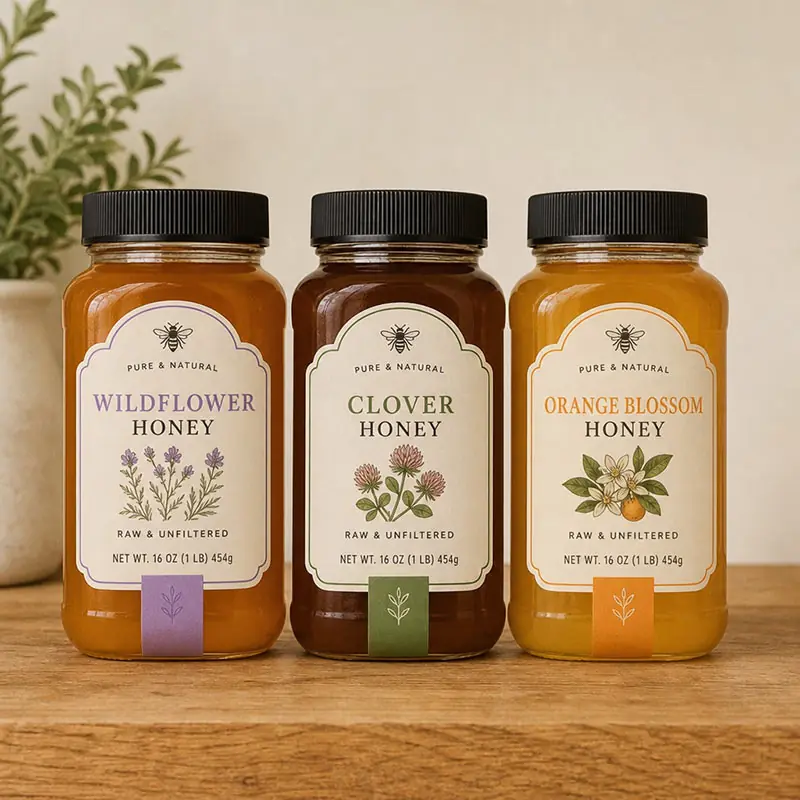
For example, a brand may need the same structure across clover honey, orange blossom honey, wildflower honey, and hot honey, with only color, flavor name, and product details changing. Another company may need labels adapted for several retailers while keeping the same jar size and brand framework. In both cases, direct production support helps prevent small inconsistencies from becoming a packaging problem.
Consistency is also important for bulk honey labels. Larger orders may require dependable color matching, correct roll direction, barcode clarity, and packaging that works with manual or machine application. These details may not sound exciting, but they affect speed, presentation, and customer confidence.
Better material choices improve the finished jar
The label material influences how the jar feels in the customer’s hand. Paper can feel natural and traditional. Clear film can look modern and clean. Textured stocks can support premium positioning. Gloss finishes can brighten colors, while matte finishes can create a softer, more refined appearance.
A direct factory can help brands match material to use case instead of choosing only by appearance. If jars are handled frequently, shipped in cases, displayed in refrigerated environments, or packed in gift boxes, the label must support that journey. A beautiful label that scuffs, lifts, wrinkles, or becomes hard to read can weaken the entire product experience.
Brands should think through these questions before ordering:
- Will the honey jar be glass, plastic, or a specialty container?
- Will the label be applied by hand or by machine?
- Does the product need front and back labels, a wraparound label, or a lid seal?
- Will the jar be exposed to moisture, temperature changes, or heavy handling?
- Is the desired look rustic, premium, playful, clean, organic, or gift-ready?
- How often will the brand need reorders or design updates?
These answers help the factory recommend label options that make sense for the real product, not just the design mockup.
Direct production can support better cost control
Working directly with a Honey Label Factory may help brands manage cost because the discussion is closer to the source of production. Rather than guessing which options affect pricing, brands can ask how size, material, finish, quantity, and setup choices influence the final order.
This does not mean every label should be the cheapest possible option. A low-cost label that fails on the jar or makes the honey look generic can cost more in lost confidence. The goal is to choose the right level of quality for the product, channel, and margin.
Direct production also helps brands plan ahead. If a company knows it will need several batches of honey jar labels over the season, it can organize artwork, quantities, and reorder schedules more efficiently. For fast-growing brands, that planning can reduce last-minute stress and make packaging feel like part of the business system rather than an emergency task.
What should brands prepare before ordering honey labels?
Brands should prepare jar details, artwork requirements, product information, quantity needs, and application method before ordering honey labels. The more complete the brief, the easier it is for the factory to recommend the right label size, material, finish, and production approach.
A useful label brief can include:
- Jar photos or measurements, including diameter and height
- Desired label shape and placement on the container
- Brand logo, colors, fonts, and existing packaging examples
- Product names, flavor varieties, net weight, and required copy
- Barcode, batch, nutrition, origin, or regulatory information if applicable
- Preferred finish, such as matte, gloss, clear, kraft, or foil detail
- Estimated order quantity and future reorder expectations
Even if the design is not final, these details help the factory identify possible issues before printing begins. They also make honey label printing more efficient because fewer assumptions are needed.
FAQ
What makes custom honey labels different from standard stickers? Custom honey labels are designed around the jar, the product, and the brand. They need the right size, adhesive, finish, and information layout so they look professional and function well on honey packaging.
Can a factory help with honey label design? Many factories can support the production side of honey label design by checking dimensions, print readiness, material compatibility, and finishing options. If full creative design is needed, brands should confirm whether that service is available before starting.
Are bulk honey labels only for large companies? No. Bulk honey labels can be useful for growing brands, co-packers, seasonal producers, and private label honey programs that need consistent packaging across larger runs or repeat orders.
What should I check before approving a proof? Review spelling, product names, net weight, barcode quality, colors, trim lines, label size, and all required product information. It is easier to correct a proof than to fix finished labels after printing.
The takeaway for growing honey brands
The reason behind Why Honey Brands Prefer Working with a Direct Honey Label Factory is simple: packaging becomes easier to control when brands work with the people producing it. Direct communication supports clearer decisions, stronger material choices, better repeat consistency, and fewer avoidable mistakes.
For honey brands building retail lines, gift products, seasonal batches, or private label honey programs, labels are part of the product experience. A thoughtful direct factory partnership can help each jar look more professional, feel more intentional, and reach customers with packaging that supports the quality inside.