Wholesale Cosmetic Labels for Beauty and Skincare Brands
If you’re building a beauty or skincare line, labels can feel like a small detail—until they start peeling off in a steamy bathroom, smudging under oil, or failing a retailer’s compliance check. Getting wholesale cosmetic labels right is one of the easiest ways to make your product look premium, stay compliant, and survive real-world handling.
Table of Contents
What “wholesale cosmetic labels” really means (and why it matters)
When people say Wholesale Cosmetic Labels for Beauty and Skincare Brands, they usually mean ordering labels in volume to lower per-unit cost and keep packaging consistent across runs. But “wholesale” also affects how you plan:
Lead times and reorders (especially when formulas or claims change)
Storage (roll labels can be sensitive to heat/humidity)
Version control (shade names, scent variants, seasonal collections)
Compliance and traceability (lot/batch and date coding)
If you’re working with private label cosmetics, wholesale labels become even more important because you may be coordinating with a contract manufacturer and switching SKUs quickly—meaning label files must be precise and easy to update.
Choosing the right supplier: what to ask before you buy
A good bulk skincare label supplier should be able to answer practical questions without guesswork. Before placing an order, ask:
What are your minimum order quantity label printing options by size/material?
Can you match colors across reprints (and do you offer proofs or press checks)?
Do you support variable data for compliant batch code and expiry labels?
Can you recommend label adhesive for glass bottles and for plastic tubes?
How do you test durability (water, oil, abrasion, refrigeration, heat)?
Cosmetic label compliance: don’t leave this to the last minute
Even beautiful labels can become expensive waste if they’re not compliant. Most brands need to think about FDA cosmetic labeling requirements (especially for products sold in the U.S.) and ingredient formatting rules like INCI ingredient label guidelines.
Common label elements to plan space for:
Identity statement (what the product is)
Net contents (proper units and placement)
Business name and address (manufacturer/packer/distributor)
Ingredient declaration (INCI names, correct order)
Warnings (when applicable)
Country of origin (as needed)
Lot/batch code and sometimes expiration/PAO support
Practical tip: build a “compliance margin” into your design—extra room for warnings, shade names, or claim edits. It’s much cheaper to update text than redesign a whole layout.
How to design cosmetic labels that look premium and print cleanly
If you’re wondering how to design cosmetic labels, start with durability and readability, then style.
A simple workflow that saves money:
Choose the container first (glass, PET, HDPE, tube, jar, pump).
Decide your label type (wrap, front/back, or single panel).
Map the “must-have” compliance text first.
Design around hierarchy: brand → product name → key benefit → details.
Confirm print specs (bleed, safe zone, barcode requirements, finishing).
Design details that often improve shelf appeal:
High-contrast text for small sizes (think eye cream jars)
Clear ingredient block with consistent spacing
A “system” for variants (color band, icon, scent name locati0n)
This is also where private label packaging labels can go wrong: manufacturers may provide a template, but the brand still needs to ensure the hierarchy and compliance text aren’t squeezed into unreadable type.

Cosmetic label materials and finishes: what works in bathrooms and handbags
Your choice of cosmetic label materials and finishes decides whether labels last through oil, water, and daily handling. For most skincare, you’ll be choosing between film and paper—especially BOPP vs paper labels.
BOPP vs paper labels (the practical difference)
BOPP (polypropylene film): tough, moisture-resistant, great for showers and oily products. Often the default for waterproof oil-resistant labels.
Paper labels: can feel artisanal and soft-touch, but may scuff or absorb moisture unless protected with lamination/coating.
If your products live in wet environments (shampoo, body wash, exfoliating scrubs), BOPP or similar films plus the right topcoat is usually safer.
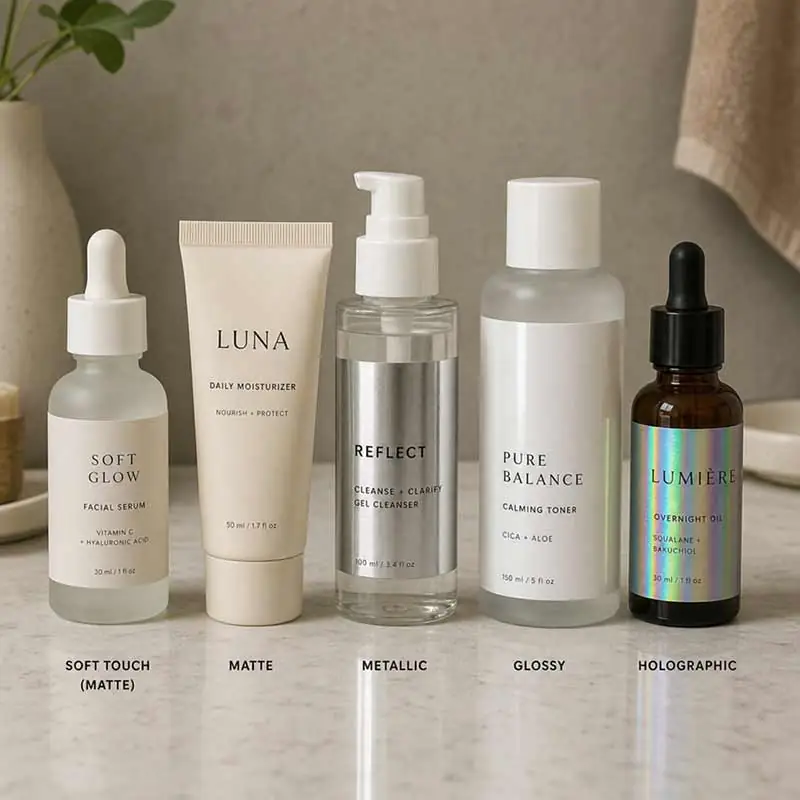
Finishes that change both look and performance
Matte laminate: modern, reduces glare, adds scuff resistance
Gloss laminate: vibrant color pop, easy wipe-down
Soft-touch: premium feel, but can show scratches
Foil accents: luxury cues, but plan around small type readability
Spot UV: contrast and emphasis, but may highlight fingerprints
Adhesives: the invisible reason labels fail
If you’ve ever searched why cosmetic labels peel off, the answer is often adhesive + surface + environment (not just “bad printing”).
Common causes:
Condensation on refrigerated serums and masks
Oils migrating (especially around caps and droppers)
Textured containers reducing contact area
Low surface energy plastics that resist bonding
Applying labels too soon after filling (warm bottles, residue, moisture)
For label adhesive for glass bottles, you typically want a permanent adhesive rated for cold and wet conditions if the product is refrigerated or used in the shower. For plastics, you may need an adhesive designed for PET/HDPE, depending on the container.
Quick in-house test you can do:
Apply labels to filled containers.
Leave some in a hot bathroom, some in a fridge, some in a bag with friction.
Check edges after 24 hours, 72 hours, and 2 weeks.
Printing options: matching budget to brand stage
“Cosmetic label printing” covers a lot, from tiny batches to major runs. Your best method depends on volume, SKU count, and how often you change designs.
Custom cosmetic label printing for growing brands
If you’re scaling, custom cosmetic label printing via professional digital or flexo production helps you:
maintain consistent color,
use specialty finishes,
reduce failure rates (curling, lifting, ink rub).
Digital is often great for many SKUs and frequent updates; flexo shines for long, stable runs.
Best label printers for small batches (when you’re not ready for wholesale yet)
Sometimes you need 50–200 labels fast for a pop-up or market test. People often ask about the best label printers for small batches, and the real answer is: choose based on material compatibility and durability needs.
Practical guidance:
For water/oil exposure, prioritize printer/ink systems that won’t smear and pair them with a compatible laminated label stock.
Test a full lifecycle: printing, handling, oil contact, and water splash—before committing to a method.
If you’re producing private label cosmetics in short runs, a hybrid approach can work: professional wholesale labels for hero SKUs, in-house for limited seasonal drops.
Batch, expiry, and variable data: plan it like a system
A lot of brands overlook traceability until a retailer asks for it. Build a consistent approach for:
lot/batch code placement,
date format,
whether expiry is printed, stamped, or stickered.
For compliant batch code and expiry labels, decide whether you need:
a blank space on the main label for inkjet/thermal coding,
separate small date-code stickers,
or variable data printed directly by the label supplier.
This also affects your label finish: some laminates resist certain inks, so confirm coding compatibility early.
Sustainable eco-friendly label options that don’t sacrifice durability
Sustainability can be real—not just a vibe—when you make choices that fit your product environment. Sustainable eco-friendly label options include:
FSC-certified papers (best for dry products)
Thinner film constructions to reduce material use
Wash-off adhesives for certain packaging recovery streams
Linerless or recycled liners (supplier-dependent)
Water-based inks and lower-VOC processes (where available)
The tradeoff: the most eco-friendly option isn’t always the most bathroom-proof. If your label must be waterproof oil-resistant labels, you can still improve sustainability through material reduction and smarter packaging recovery choices rather than switching to paper that fails.
Ordering wholesale without headaches: a practical checklist
Before you approve your first “real” run of wholesale cosmetic labels, double-check:
Final container measurements (including taper and label application area)
Dieline accuracy (corners, wrap overlap, seam placement)
Ingredient list locked (INCI names, order, allergens if relevant)
Claims consistent with the rest of your packaging and marketing
Barcode size/quiet zone (if used)
Finish choice aligned with coding method
Storage plan for label rolls (cool, dry, sealed)
And if you’re running multiple collections, create a naming/version system so you don’t accidentally reorder an old file.
Takeaway
Labels are the intersection of branding, engineering, and compliance. When you treat Wholesale Cosmetic Labels for Beauty and Skincare Brands as a product component—not an afterthought—you get fewer failures, smoother reorders, and a more premium unboxing experience. Choose materials and adhesives based on where the product will live, build your layout around FDA cosmetic labeling requirements and INCI ingredient label guidelines, and test early so your next wholesale run doesn’t turn into expensive scrap.